| General Conditions for the Manuscript |
| Manuscript Structure |
| Article Title |
The title must be precise, descriptive, concise, and fluent, maintaining a direct and comprehensive connection to the research content. It should clearly reflect the core idea and central themes addressed in the body of the manuscript.
| Abstract |
The abstract provides a comprehensive, concise, and clear overview of the manuscript’s content. Its writing style differs from the introduction and main body and must be prepared only after the research is fully completed and the manuscript is finalized. Consequently, authors must avoid verbatim repetition of sentences from the introduction, body, or conclusion within the abstract.
The abstract is prepared in two languages:
1. English Abstract:
- Word count: Between 1,000 and 1,500 words. (Note: Please verify if this range refers to characters/words as per journal editorial policy).
- Formatted as a detailed structured abstract comprising the following four sections:
1. Introduction and Objective2. Methodology3. Research Findings4. Conclusion 2. Persian Abstract:
- Formatted as a structured abstract comprising the following four sections in order: Introduction and Objective, Methodology, Research Findings, and Conclusion.
| Keywords |
Keywords represent the primary and central concepts used in the research and must be extracted directly from the text. Each article must include 4 to 7 keywords.
| Introduction |
The introduction must include preliminary explanations of the research topic, problem statement, justification for the study, primary research objective(s), a brief overview of the manuscript structure, research questions or hypotheses, literature review, and finally, an explanation of the research methodology.
This section must be written in such a way that readers obtain a clear, cohesive, and comprehensive picture of the manuscript’s content and research trajectory upon reading it. At the end of the introduction, the headings “Literature Review” and “Research Method” must be prominently displayed as independent subsections.
| Main Body |
The main body, developed in accordance with the article outline, must be logically and cohesively divided, sectioned, and numbered. Main and subheadings must be numbered sequentially, distinguished from the right side of the page, separated by dots in the numbering sequence, and terminated with a period at the end of each heading.
| Conclusion |
The conclusion must synthesize the research problem, provide a summary of the manuscript’s content, explain the logical findings of the research, highlight the innovations and academic achievements of the article, and present recommendations derived from the research findings.
In articles where the conclusion entails specific recommendations (such as proposals for amending regulations, policies, or legal articles), authors may include an independent subheading titled “Recommendations” immediately following the “Conclusion” section to present suggestions derived from the discussion and results.
| References |
In addition to in-text citations used throughout the manuscript, a complete list of cited references must be included at the end of the article in accordance with APA style (7th edition). Authors may consult “this page” for referencing guidelines.
Only sources cited within the text must appear in the reference list. Sources consulted during the research process but not cited in the text must be omitted. In other words, the reference list is strictly a compilation of in-text citations accompanied by complete bibliographic information formatted in APA style.
| References |
| Formatting and Typography Guidelines |
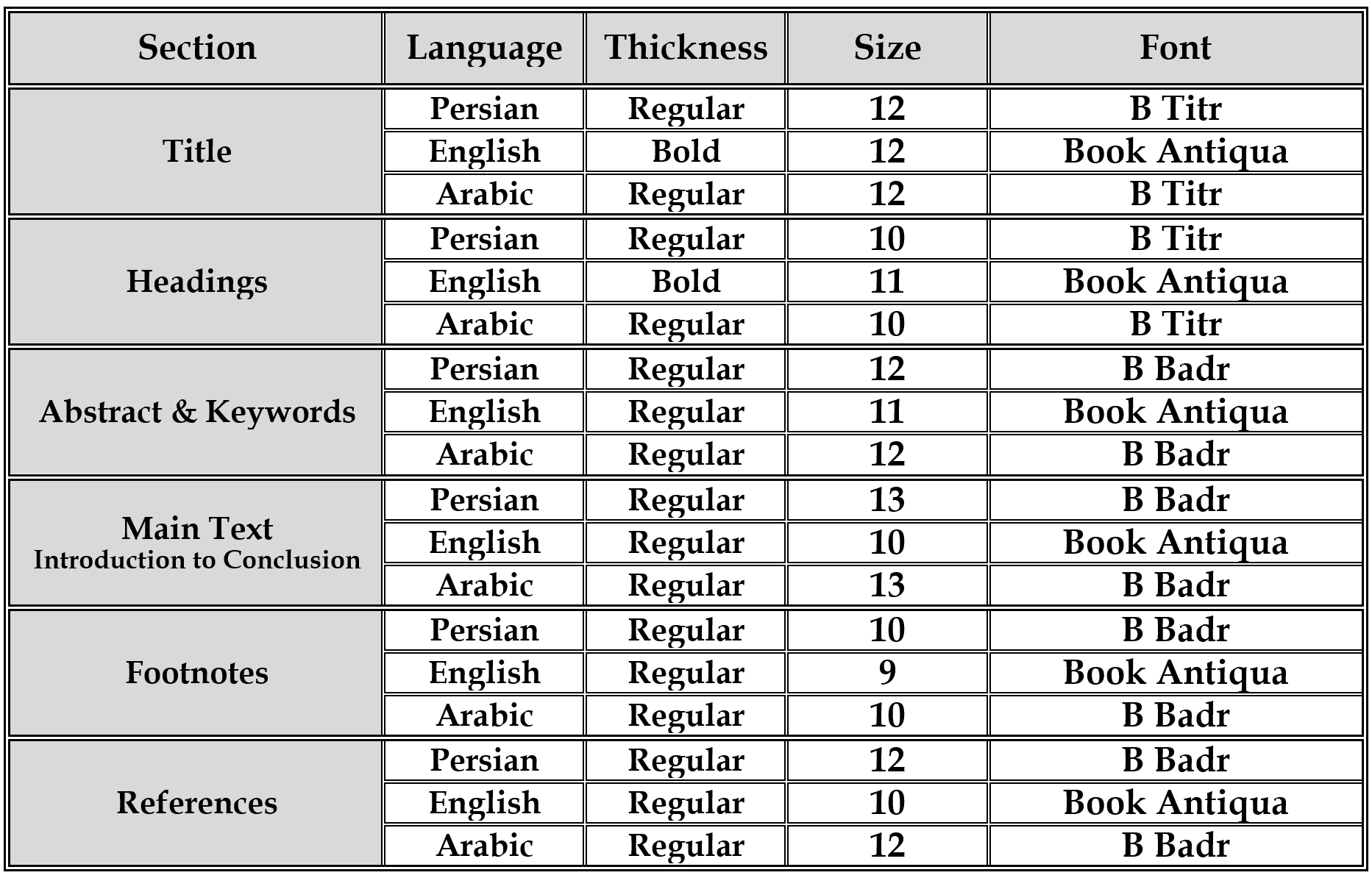
 Islamic Economics Studies (IES)